A production platform with live AI agents
Used daily by colleagues and customers. I designed it, built it alone with AI coding agents, and run it, alongside a full-time account-management role.
What it is
Software for an account-management team and its customers. It replaced work the team did in spreadsheets, vendor portals and emailed reports, and it gives customers their own data without asking staff for it.
It began in December 2025 as a single export tool. It now has twelve modules and 25 registered AI features.
Fetch in daily use
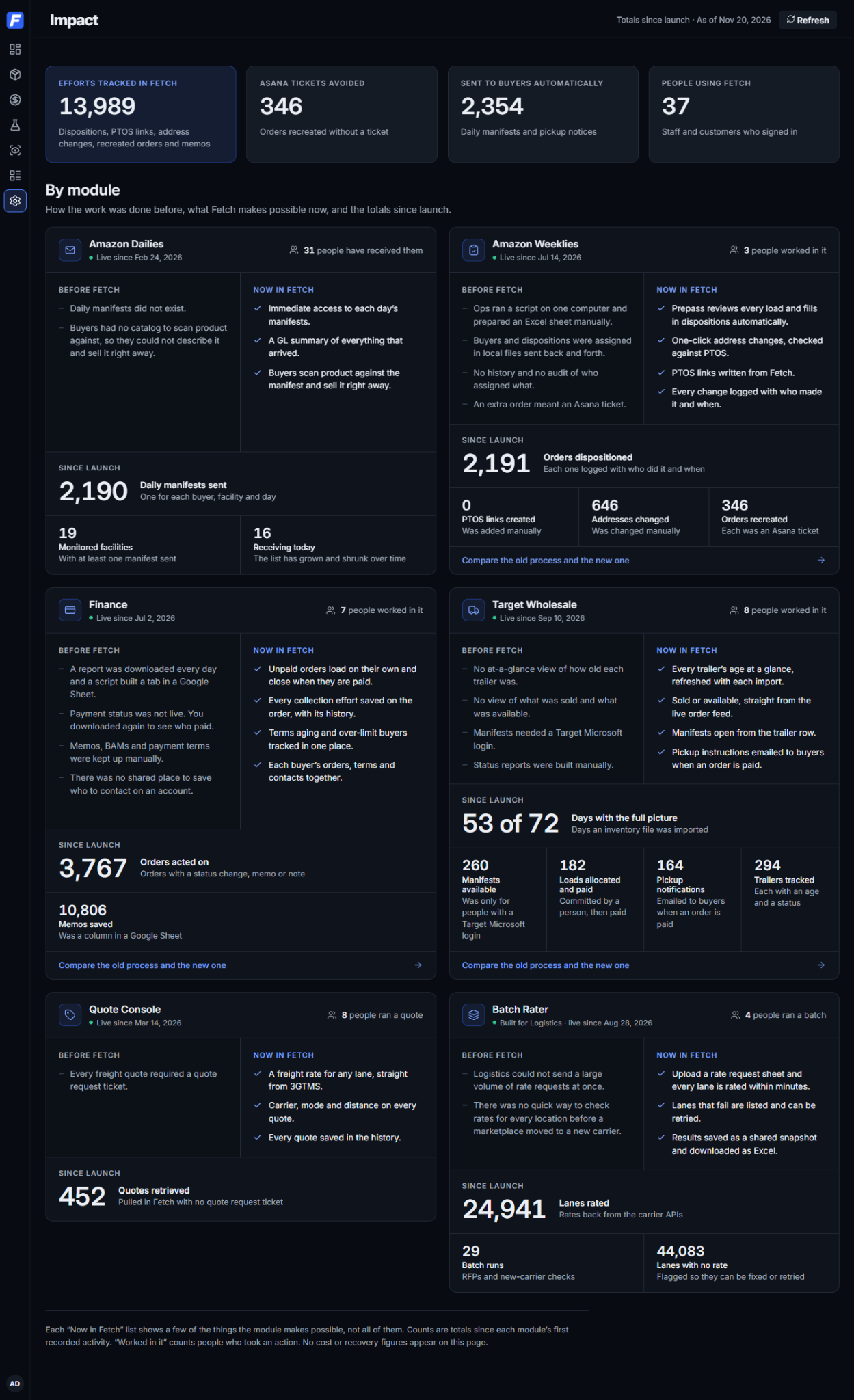
By November 20, 2026, Fetch had sent 2,190 daily Amazon manifests to buyers. The team had recreated 346 Amazon orders without opening an Asana ticket. Customers and buyer account managers had retrieved 452 freight quotes directly.
The agents
| Agent | What it does | What limits it |
|---|---|---|
| Customer agentText message | Answers customers' questions about their own orders. | Fixed lookup tools. Seven code checks and a judge model on every reply. One rewrite by a second provider's model, then a block and a hand-off to a person. Daily caps on messages and on spend. |
| Search agentInternal | Takes a request in plain words and returns a ranked list, with the evidence for each result. | Schema-checked tools. Records reach the model as numbered IDs, not names. Dollar caps per run and per day, checked before every turn. A result whose evidence no tool returned is dropped. |
| Triage and draftingInternal | Classifies inbound messages and support cases, and drafts replies and outreach. | A person sends every one. |
Agents run on text message and realtime voice. Each is switched on in shadow mode before it goes live.
One text message, start to finish
The eight checks
Checks 1 to 7 are code. Check 8 is a separate decision model (Jev), and its score has to clear a set threshold.
What happens next
- All eight pass→The reply is sent.
- Any check fails→A second provider's model rewrites the draft, and all eight checks run again.
- It fails again→The reply is blocked. The customer gets a holding message and a person takes over.
Evaluation
- ShadowA new agent or prompt runs in shadow first. It drafts replies and nothing is sent.
- VersionsEvery prompt has a version. Pass and block rates are tracked for each one.
- GradingI read the replies, mark each one right or wrong, and write the reply it should have given.
- ReplayFailures from production are replayed as tests against a throwaway PostgreSQL database.
- BacktestsThe ranking model is tested on a later period it was not built from, on every build.
Where code decides
Governance
- RegisterEvery AI feature is listed on one admin page with its risk tier, model and exact prompts. 25 features on November 11, 2026.
- BudgetsDollar caps per run and per day, checked before every turn. A model without a price cannot start a run.
- Audit logChanges to models and prompts are written to an append-only log.
- Build checkAn AI call that is not in the register fails the build.
- TelemetryError reporting drops AI inputs and outputs.
How it was built
I decide what to build and how each part should behave. AI coding agents write much of the code. Automated tests and build checks hold the result to that behaviour.
The build fails if
- Dataa restricted column can reach a customer view
- Schemathe database schema changes outside a migration
- AIa model is called without being registered
- Typesa value is left untyped
Commits per month, December 2025 to November 2026. November is a partial month.
Underneath
Scale
Counted from the codebase on November 11, 2026.